Friday, June 9, 2023

COME INTO THE GARDEN VITA

 And speaking of walking in gardens (as we almost were), there’s a 1927 love letter from Virginia Woolf to Vita Sackville-West, that some sources will tell you is one of the great love letters of our time. 


    In that letter Woolf writes,Look here Vita — throw over your man, and we’ll go to Hampton Court and dine on the river together and walk in the garden in the moonlight and come home late and have a bottle of wine and get tipsy, and I’ll tell you all the things I have in my head, millions, myriads — They won’t stir by day, only by dark on the river. Think of that. Throw over your man, I say, and come.’


         I’ve always had found this a bit confusing. When she says ‘dine on the river,’ does she mean that they should actually eat in Hampton Court Palace and then walk in the garden? And does that mean Hampton Court was open at night for dining and walking? It currently closes at 5.30, with last admission at 4.30 but no doubt it was different in those days.  Or maybe the whole thing was a literary conceit.


We all know that Virginia was something of a walker, Vita perhaps less so, though there’s a radio talk she gave in 1950 titled ‘Walking Through Leaves.’  She explained that the title referred to ‘the small but intense pleasure of walking through dry leaves and kicking them up as you go, they rustle, they brustle, they crackle – and if you crunch beech nuts underfoot at the same time then so much the better”.  

         Ah, the nuts …


        Of course we know that Vita did not throw over her man – Harold Nicolson, and he was not easily thrown.  She did briefly leave him for Violet Trefusis but he was having none of that: he pursued her and brought her back home.


That was in 1920, six years before she met Virginia.  In 1930 Vita and Harold moved into Sissinghurst where Vita became famous for her gardening, if rather less so for her novels and poetry. Interestingly (perhaps) there is a series of ‘walks’ within the garden: the Lime Walk, the Moat Walk and especially the Nut Walk. 


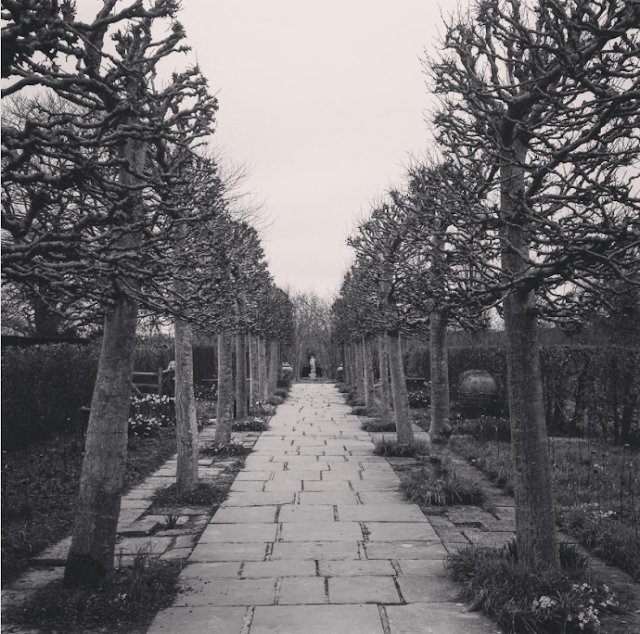
In April 1930, Harold wrote in his diary about the moment he and Vita made up their minds about Sissinghurst: 'We came suddenly upon the nutwalk and that settled it.' 

This is Harold’s Nut Walk at Sissinghurst.


Monday, June 5, 2023

WALKING ROUND WEIWEI

 We’ve discussed previously whether or not Ai Weiwei is much of a walker.  The jury is still out, although hard core ‘walking art’ is one of the few conceptual practices he hasn’t embraced (as far as I know – I stand to be corrected). In any case here he is at least strolling in Portugal where he now lives.


However if you go to London’s Design Museum to see the Ai Weiwei: Making Sense exhibition, you do have to do a certain amount of walking as you explore the huge space where the works are displayed and laid out.


There are video screens showing 20 hour video pieces, his photographs of liminal spaces in Peking, other photographs of the Birds Nest National Stadium on which he worked as an ‘artistic consultant’ before deciding he didn’t want to be a ‘tool of government propaganda’ – I’m quoting from the catalogue there.


And there are 5 large pieces laid out on the floor, which the Design Museum describes as ‘fields,’ rectangular expanses filled with broken teapot spouts, chunks of porcelain from Weiwei’s sculptures that were destroyed when his studio was demolished by the Chinese authorities in 2018.  There are also Lego bricks, porcelain cannon balls, and my favourite by miles, rows and rows of what the museum says are Stone Age tools, some 1,600 of them.


This work is titled Still Life and I believe it was shown in a different form at the Royal Academy a few years back, and that consisted of 3,600 Stone Age items rather than 1,600.


This does, as they say, raise some interesting questions.  We’ve often discussed the joy of picking up rocks, stones and detritus while walking and I would definitely pick up a Stone Age tool if I came across one on my travels. But so far I haven’t had that pleasure.


Some sources describe these items as ‘found objects’ but where exactly do you find 3,600 Stone Age tools?  Where do you find even one?  The Design Museum says they were bought at flea markets, and I know that Chinese culture is inscrutable, but a flea market where you can pick up a few Stone Age tools, well that's obviously a flea market unlike any most of us have ever seen.


Which reminds me somewhat of Jim Ede, the man behind, and sometimes in front of, Kettle’s Yard in Cambridge – there’s a new biography by Laura Freeman, titled Ways of Life.  Ede was a collector, curator, patron of the arts, and it’s a long time since I visited Kettle’s Yards but I do clearly remember the displays of carefully arranged stones and pebbles, seen on the book cover and in the house/gallery itself.


And the result of all this was that I found myself in my shed rearranging a few of the rocks I’ve collected while walking.    I’m no Ai Weiwei, but I think we already knew that.


Photo, and artistic consultancy by Caroline Gannon


Friday, June 2, 2023

SINCLAIRIAN RETURNS OF THE DAY

 I read online that yesterday was young Iain Sinclair's birthday.  80 years and still counting.  So I wrote this post.

    Then, incredibly, I found that not all information on the Internet is 100% correct, and his birthday is in fact on the 11th.  Ah well, it's the thought that counts.


And today the postman brings me a copy of Sinclair's Agents of Oblivion, published by The Swan River Press. I don't know much more than what it says on the front flap.  Four  stories (not necessarily fictions), 'starting everywhere and finishing in madness' inspired by Ballard, Lovecraft, Machen and Blackwood.  What more could you want? Expect a more nuanced response in due course.

And another reason I know it's gonna be good is that it comes with a bookmark and a free badge!


Tuesday, May 23, 2023

A LONG WAY TO WALK

 Will Pavia interviewed the now late Martin Amis in 2018, 

when Amis was in his late 60s, not so very long before 

his death as it turns out.

Amis said, ‘I’m more and more averse to any kind of exertion.’  And then discussing the walk to his local grocery store he said, ‘When I come around the corner and look up the street (I think) that’s a long way.’ 

I wonder if it had something to do with the cigarettes.


From the Smithsonian magazine

You know, sometimes I look out of my window and see old people struggling with walking sticks and Zimmer frames and occasionally Nordic poles, and I admire them enormously because they’re still out there, determined to carry on walking.  But at the same time I think, if I had that much difficulty walking, if I needed a stick or a Zimmer frame or Nordic poles I don’t think I’d ever leave the house.  No doubt time will tell.


Monday, May 22, 2023

IT'S NOT THE REST ...


Because I’m such a cool and well-connected guy, people sometimes send me things, books mostly, and last week my own publisher sent me this, Calligraphies of the Desert by Hassan Massoudy.


Massoudy has a reputation as one of the world’s great calligraphers, this is him:


and although this isn’t my area of expertise, I can see it’s a terrific publication, works of calligraphy inspired by thoughts and quotations about the desert.


And because of the nature of the subject, one or two of the quotations also relate to walking. There is, for example, a Bantu proverb, ‘It’s not the rest that reduces the distance, it’s the walking,’ which seems unarguable.  And the Bantus knew of what they spoke.  

This is just one more area in which I lack expertise but I’m aware of the Bantu Migration.  By some accounts (meaning that it’s a contested anthropological hypothesis),  4,000 to 5,000 years ago (estimates differ), about 300 million members of the Bantu-speaking population roamed many, many thousands of miles, most by walking I assume, from the Niger Delta all across southern Africa eventually to what is now Angola and Zambia, looking for new places to settle.  


Elsewhere in Massoudy’s book there’s a quotation from St Augustine ‘Go forth on your path, as it only exists through your walking.’  I like that, although I assume there most be some paths that exist because of other people’s walking.


      The quotation comes from St Augustine of Hippo, not to be confused with St Augustine of Canterbury who landed in Kent baptised King Ethelbert in 597, and in due course set England on the course of conversion to Christianity.  


In his memory there is now a walking trail, the Augustine Camino from Rochester Cathedral to the Shrine of St Augustine in Ramsgate: 


To be fair, Saint Augustine of Hippo’s walks look a bit more lively.


Thursday, May 18, 2023

STUMBLING IN THE SHRUBBERY (FOR INSTANCE)

I’ve been thinking there might be a book to be written, and one that I could possibly write, about walking in gardens. Of course I wouldn’t call it Walking in Gardens – that sounds like something Alan Titchmarsh would write – I’d be going for something like Shambling in Eden (yes, yes I know it needs work).

And of course it wouldn’t be all about the joys of walking around, say, the Chelsea Physic or Kew, though here, for reference, are some people walking in Kew:


I’d be more concerned with, say, the Poison Garden in Alnwick, Ian Hamilton Finlay’s Little Sparta, Charles Jencks’ The Garden of Cosmic Speculation, and so on. 


Photo by Richard Tulloch (I think)


And of course I’d also be concerned with imaginary or fictional gardens, the suicide garden in You Only Live Twice


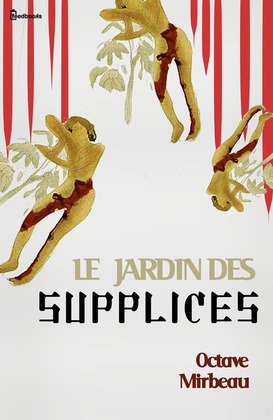
and perhaps most obviously the one in Octave Mirbeau’s The Torture Garden (Le Jardin Des Supplices), a book that’s obviously driven jacket designers mad over the years.


 There’s also a somewhat faithful film, Le Jardin Des Supplices 1976 directed by Christian Gion:


and there’s the 1967 film Torture Garden starring Jack Palance and Burgess Meredith that has almost nothing to do with the novel, but hey, it stars Jack Palance and Burgess Meredith.


And so, as research, I’ve been rereading the novel. The edition I own is the one above with Catherine Deneuve on the cover, and it also has a quotation on the back from my cineaste pal Anne Billson ‘This decadent classic flays civilised society down to its hypocritical bones and is le denier cri in kinky exoticism.’  Fair enough. She knows of what she speaks.


Self-portrait by Anne Billson from her blog Multiglom.

There’s a key scene in the book where the narrator goes walking in the Torture Garden, which is at the centre of a prison, with Clara, the deracinated English ‘heroine’ who only feels at home and free in China, where the garden is located. 

(Spoiler alert - everything grows so well in the garden because it’s fertilized with the corpses of tortured prisoners; actually not much of a spoiler, you would almost certainly have guessed)


Clara started walking again, very quickly … She walked on – a hard shadow on her eyes and her eyes aflame… Clara continued walking.  I walked beside her and everywhere was a fresh surprise … Suddenly Clara stopped as though an invisible arm brutally descended on her. 

‘Do you smell it?’

‘I smell the aroma of peonies.’ 

       ‘No that’s not it ... it smells as it does when I make love with you … Here it is here it is oh my darling.’

In fact a powerful phasphatic odour, an odour of semen wafted up from that plant (a ‘thalictus’ in the text, the RHS prefers the term thalictrum)  

‘Why do so many flowers resemble sexual organs if not because nature ceaselessly cries out to living beings in all its forms and through its perfumes, ‘Make Love.’


I don't doubt that Gertrude Jekyll and Vita Sackville West felt much the same way. 


Friday, May 12, 2023

THE WALKING GAZE, THE GAZING WALK

This is a depiction of a flaneur:


It’s by Honoré Daumier, and is an illustration for M. Louis Huart’s Physiologie Du Flaneur, 1841.


The binoculars are a worry aren’t they? I mean they’re not likely to be very useful for looking at anything in the street are they? Things are surely close enough that you don’t need a powerful lens to zoom in on anything.  Compare and contrast with the popularity of the basic 28mm lens as used by a great many street photographers, not least Garry Winogrand.


Though other camera options were available, as Diane Arbus demonstrates here.


This is the title page of Physiologie Du Flaneur, 


which does suggest that the flaneur is a bit of a lech, watching all the girls go by, maybe even following them.  This is of course all about the male gaze.  According to Priscilla Parkhurst Ferguson in her Paris as Revolutionthe flaneur’s gaze ‘begins in the activity of following women.’  This seems impossible to prove or disprove. 


Certainly this fellow, Le Flaneur Parisien by Theophile Steinlen looks dead dodgy, whether he’s about to follow the woman or not.


At least you couldn’t accuse any of the flaneurs illustrated here of being sneaky.  You can see exactly what they’re up to, and I’m reminded of Walter Benjamin’s words: ‘Dialectic of flaneurie: on one side, the man who feels himself viewed by all and sundry as a true suspect and, on the other side, the man who is utterly undiscoverable, the hidden man.’ These guys look completely discovered.


But you know, it was a different age.


Tuesday, May 9, 2023

CARELESS WALKING


It being the Chas and Camilla weekend, we motored over to The Place for Plants in East Bergholt, which is partly a plant-centre but also a 20 acre garden, where you can have a longish and surprisingly uncrowded walk.  The handout you get when you enter says the place is inspired by the landscape of Cornwall, though this would have passed me by if it hadn’t been pointed out.


PHOTO BY CAROLINE GANNON

There were ducks and bamboo and euphorbia if you like that kind of thing – and it so happens I do.


Last week it rained quite hard so it wasn’t surprising that parts of the garden  were wet and muddy, though in fact some parts weren’t.


Now, I may not be the most cautious of walkers but I’m not the most reckless either.  And although I understand that in the interests of heath and safety, when a garden is open to the public you may well need to put up a few warning signs, ‘Do not walk on the water’ and that kind of thing.  But I thought they overdid it at this place.


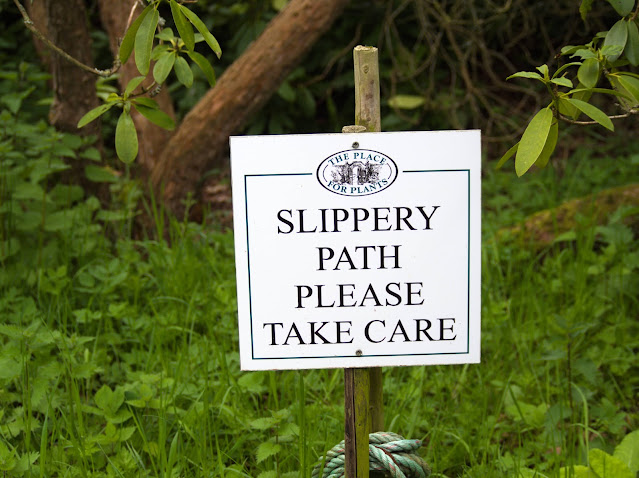
It seemed fair enough that there were signs telling people to take care:


But then there were signs telling people to take extra care.


And I’m really not sure that I know the difference between taking care, and taking extra care.  What would be the measure?  What  strategies should the extra careful walker employ, as opposed to the one who’s simply taking care?

There is possibly a philosophical walking conundrum here.  We went to the tea room.